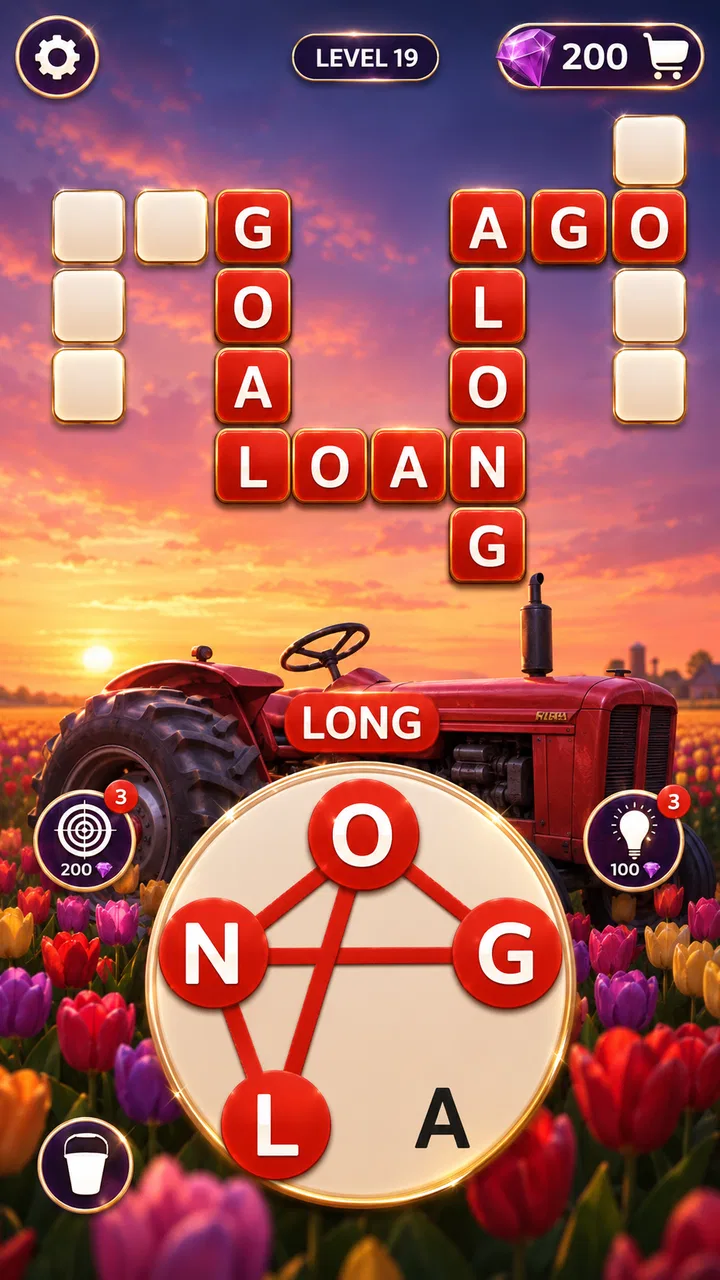
Wordlution : Word Game
- 4.8
- Rating
- 500.00K
- Installs
- Free
- Price

 Analysis by App-foxy
I went into Wordlution expecting a familiar word-game routine: open a puzzle, look for possible answers, and move on with a small sense of progress. That basic expectation is accurate, but it misses what makes this particular game pleasant to return to. Schlank Games keeps the focus on daily word puzzles and brain training, while the presentation gives each short session a calm, contained rhythm rather than turning it into a noisy competition.
That makes it easy to recommend to someone who wants a word game that fits between other tasks. I can imagine opening it with coffee, during a short commute, or when I want something more active than scrolling but less demanding than a full game. It is free to start, aimed at Everyone, and available on devices running Android 6.0 or later. The current version is 2.0.8, so it also feels like a maintained choice rather than an abandoned puzzle experiment.
The game has built a strong audience for this format, with an average rating of 4.8 from around eleven thousand ratings and over five hundred thousand installs. Those figures do not replace personal experience, but they do match my impression that the core appeal is easy to understand: Wordlution offers a compact daily habit without asking the player to learn a complicated rule set first.
You May Also Like

 Blood Strike: 2.5 Anniversary
Blood Strike’s Loadouts Turn Every Drop Into a Tactical Gamble
A close look at Blood Strike’s custom loadouts: how fast access to signature weapons reshapes its battle royale rhythm, rewards preparation, and narrows the gap between fights.

 Pandora - Music & Podcasts
Pandora’s Music Is Easy to Start, but Harder to Recover
Pandora’s strength is its low-effort path from a seed to a station. Its weak spot is how much confidence it asks you to place in connection, setup, and quiet recovery.

 8 Ball Pool
 Is Built on Rivalries, Rematches, and Routine
A close look at the rivalries, rematches, shared routines, and unanswered safety questions that turn a quick pool match into a persistent mobile community.

 Samsung Music
’s Quiet Strength Is Playing What You Already Own
Its reach comes less from spectacle than from dependable access to a personal library. That simplicity is both the app’s strongest retention engine and its ceiling.

 AccuWeather: Weather Radar
AccuWeather Review: A Quick, Clear Forecast for Everyday Decisions
For everyday plans, the best forecast is the one you can understand quickly. AccuWeather makes rain timing, radar, and local conditions easy to act on, with a few trade-offs.

 Hill Climb Racing
Why Hill Climb Racing Still Turns Crashes Into One More Run
A tiny car, a bumpy hill and one more upgrade: Hill Climb Racing keeps resurfacing because its simple chaos makes every near-miss feel personal.
More From Our News Desk



A quiet first impression that gets to the puzzle quickly
The first thing I noticed is how little ceremony the concept needs. A word game succeeds or fails on whether the player can understand the immediate task, and Wordlution does not bury that purpose under a large amount of setup. The store short description calls it “Wordlution,” while the actual experience is more clearly defined by its daily crossword-style puzzles and the steady invitation to keep your mind working.
That directness is useful for casual players. I do not need to prepare a long session or remember a complicated story before I can enjoy it. The game’s identity comes from the act of solving, not from an elaborate fictional world placed around the puzzle. For me, that creates a clean first impression: this is a small mental exercise designed to become part of a routine.
The free entry point matters here. A player can try the basic experience without making a purchase, which lowers the risk of discovering that the puzzle style is not a good personal fit. In-app purchases range from $0.99 to $69.99 per item, so I would still advise checking the purchase flow carefully before spending. The free starting point is attractive, but the presence of optional paid items means the game is not best understood as a completely purchase-free experience.
I also appreciate that the age rating is Everyone. That does not automatically make every puzzle suitable for every level of vocabulary, but it signals a broadly approachable presentation rather than an adult-focused theme. I would be comfortable suggesting it to families who want a simple word activity, although younger players may still need help with unfamiliar words or clues depending on their reading ability.
Who will settle into it quickly
Wordlution is strongest for people who enjoy short, repeatable word challenges. If you like crossword-style thinking but rarely have time to sit with a newspaper puzzle for a long stretch, the daily format is a natural fit. It also suits players who enjoy building a small routine around mental exercise. The value is not only in finding an answer; it is in returning regularly and noticing how your approach changes from one puzzle to the next.
I would be less likely to recommend it to someone looking for a large adventure, a character-driven campaign, or a game with constant action. The appeal is deliberately narrow. Players who need a strong narrative setting may find the experience too restrained, while people who prefer endless random challenges may want a more expansive word-game alternative. Wordlution works because it concentrates on a particular kind of session, not because it tries to cover every possible form of entertainment.
The world is built from language rather than scenery
The setting in Wordlution is essentially the puzzle space itself. That may sound obvious, but it shapes the mood in a useful way. Instead of asking me to care about a cast of characters or a fictional location, the game asks me to pay attention to relationships between words, clues, and possible answers. The language becomes the environment I explore.
This approach gives the game a coherent identity. A crossword game does not need a dramatic backdrop to feel purposeful, and adding one could easily distract from the central activity. Here, the restrained setting lets the player notice small shifts in difficulty and vocabulary. A familiar clue can provide an immediate foothold, while a less obvious one encourages me to test associations and rethink an answer that initially seemed certain.
One of the more useful ways to play is to treat each puzzle as a process of narrowing possibilities instead of a test of instant recall. I start with the clues that feel most concrete, then use the crossing letters to challenge my first assumptions. That workflow is especially helpful when a word seems plausible but does not fit the surrounding answers. The game’s crossword foundation makes those intersections meaningful: one solved entry is not isolated progress, but a tool for unlocking another.
That is also where the brain-training angle feels most believable to me. I would not treat Wordlution as a formal educational program, but it does encourage flexible recall, spelling awareness, and the ability to hold several possibilities in mind. The benefit comes from the way the player works through uncertainty. Guessing quickly can sometimes succeed, but checking how an answer affects the rest of the puzzle is usually the more satisfying habit.
How I use the daily structure
The daily format gives the game a natural stopping point. I can play a puzzle in one sitting, pause when I need to do something else, and return without feeling that I have lost the thread of a huge campaign. That makes it particularly suitable for a morning routine or a short evening wind-down.
A practical approach is to avoid treating an unfinished clue as a failure. I fill in the answers I know, leave space around the stubborn ones, and revisit them after the grid has offered more letters. This turns the puzzle into a gradual conversation with itself. The less obvious clue often becomes easier after several crossing answers are in place, and that delayed recognition is one of the better small rewards in this kind of game.
There is a trade-off, though. A daily structure can feel limiting if I am in the mood to solve continuously. Someone who wants a large bank of puzzles immediately may find the pacing less generous than a traditional word-game collection. Wordlution’s appeal depends partly on liking the idea of a measured challenge rather than treating the app as an unlimited content dump.
Sound, visual tone, and the rhythm of a session
The atmosphere works best when it stays in the background. In a word game, sound and visual presentation should support concentration rather than compete with it. Wordlution’s overall mood is suited to quiet attention: I can focus on the wording of a clue, consider possible spellings, and enjoy the small movement from uncertainty to confirmation without needing a dramatic reward after every action.
That restrained rhythm is important because crossword solving already has its own natural pacing. There are quick victories when an answer comes immediately, followed by slower stretches where the player has to step back and make connections. A good presentation allows both moments to exist. If every solved word were treated like a major event, the experience would become tiring. If the interface were completely lifeless, the daily habit might lose some of its pull.
I find the best mood appears during those middle-length sessions when I am neither rushing nor stuck. The puzzle creates a gentle alternation between recognition and investigation. I may solve a few entries quickly, pause over one clue, then return to it after the surrounding letters suggest a different interpretation. That rise and fall is more important to the game’s atmosphere than spectacle would be.
For a realistic everyday example, I could see using Wordlution after lunch when I want a break from work without disappearing into a long game. I would solve the obvious entries first, stop before frustration builds, and come back later with a clearer head. That second attempt can feel surprisingly effective because the mind continues turning over a difficult clue in the background. The game is well suited to that kind of divided session, where progress does not require uninterrupted concentration.
Why the calm presentation is a mechanical advantage
The quiet mood is not merely decoration. It helps preserve the distinction between solving and guessing. When the game does not push me to act rapidly, I have more room to compare possible words and notice how one answer changes the rest of the puzzle. That makes the experience feel more thoughtful than a word game built around speed alone.
It also makes Wordlution easier to share with another person in the same room. One player can suggest a possibility while the other checks whether it fits the surrounding clues. The game does not need to become a formal multiplayer contest to support that kind of cooperation. Its compact format makes it suitable for occasional discussion, especially when a clue has two plausible interpretations.
The limitation is that players who want strong sensory feedback may find the atmosphere too modest. This is not the right choice if sound effects, animated rewards, or a highly theatrical setting are the main reasons you play mobile games. The presentation serves the words, and that means it will naturally feel less exciting than a more aggressively styled alternative.
Where the mechanics fit the mood
Wordlution’s central strength is the alignment between its mechanics and its intended pace. Daily crossword-style solving rewards attention, memory, and patience, while the short-session structure keeps those demands manageable. I never feel that I need to master a large system before I can begin. The challenge comes from the vocabulary and the connections between answers.
The most important skill is not simply knowing many words. It is knowing when to trust an answer and when to hold it lightly. A word that matches one clue may still be wrong if it creates an impossible crossing elsewhere. I get more from the game when I use partial information carefully: a confirmed letter can change the likely ending of a word, reveal a common pattern, or eliminate an attractive but incorrect guess.
That makes the experience useful for different skill levels. A confident solver can move quickly through familiar clues, while a less experienced player can learn to use crossings as guidance. The game does not need to reduce every puzzle to an effortless sequence, because the process of working through uncertainty is part of the appeal. At the same time, a particularly difficult clue can interrupt the flow, especially when several answers depend on it.
My advice is to protect the rhythm of the session rather than forcing completion at any cost. If I spend too long attacking one clue, the game stops feeling like a relaxing mental exercise and starts feeling like an obligation. Taking a short break, solving another section, or returning later is often more productive than repeating the same guess. That is a small but meaningful strategy for getting more enjoyment from the daily design.
How it compares with familiar word-game alternatives
Compared with a classic newspaper crossword, Wordlution feels more convenient and less formal. I do not need a printed page, a pen, or a large uninterrupted block of time. The digital format makes it easier to fit a puzzle into a daily routine, though players who enjoy physically marking a page may miss that tactile quality.
Compared with quick guessing games built around a single hidden word, Wordlution offers a broader web of clues and crossings. A single answer can help solve several others, so the satisfaction comes from building a structure rather than only finding one target. The trade-off is that the experience may feel less instantly accessible to someone who wants a very short, sharply defined round.
Compared with large word-game collections, its focused identity is both an advantage and a limitation. I like that the app does not need to constantly switch between unrelated modes to justify opening it. However, if I want anagrams, timed spelling tests, competitive leaderboards, or a wide selection of puzzle types in one place, another app may offer better variety. Wordlution is a better choice when the crossword-style daily habit is exactly what I want.
Questions I would consider before installing
One practical question is whether the game is suitable for an older device. The minimum operating-system requirement is Android 6.0, which covers a wide range of hardware, but the actual comfort of play will still depend on the phone or tablet’s condition. Since the game is designed around reading and entering words, a clear display and responsive touch input matter more to me than high-end performance.
Another question is whether I need to pay to begin. I do not need to pay before trying the game, because it is free to download and start. Still, the available in-app purchases mean I would keep an eye on confirmation screens and avoid buying anything merely to rush through a difficult clue. The most satisfying part of the experience is solving, so I would treat paid items as optional rather than necessary to understand the game.
Players may also wonder whether an Everyone rating means the vocabulary will always be easy. I would not make that assumption. The presentation is broadly accessible, but crossword solving naturally depends on reading ability, spelling confidence, and familiarity with different words. A child can enjoy it with support, while an adult who reads widely may still encounter clues that require patience.
Finally, I would ask whether it is worth installing if I only play occasionally. I think it can be, provided you like returning to a puzzle after a pause. The daily structure is most effective for regular players, but the compact format also works as an occasional mental break. It is less suitable for someone who expects a huge, constantly changing arcade-style experience every time the app opens.
Why the overall atmosphere holds together
What I like most about Wordlution is that its mood does not fight its mechanics. The word-focused setting, measured daily pacing, and understated presentation all point toward the same kind of play: attentive, quiet, and gradually rewarding. I am not being pulled away from the clues by an oversized story, nor am I encouraged to rush through every answer simply to keep up with visual noise.
That coherence makes the game feel more considered than its simple premise might suggest. A crossword puzzle can look ordinary on the surface, but the details of pacing determine whether it becomes a pleasant ritual or a source of friction. Wordlution generally lands on the pleasant side for me because it gives mistakes and uncertainty room to exist. I can think, pause, and return without feeling that I have broken the experience.
There are clear boundaries to the recommendation. I would skip it if I wanted a narrative adventure, a competitive word battle, or a deep collection of unrelated modes. I would also be cautious about recommending it to someone who dislikes daily formats or becomes frustrated when a clue does not yield quickly. The calm design is an advantage only when the player is willing to meet it at that pace.
For everyone else, I think Schlank Games has made a convincing small-scale word game. It is free to try, supports older Android versions from 6.0 onward, and keeps its main purpose easy to understand. The strongest reason to install it is not a promise of endless novelty, but the chance to build a manageable puzzle habit around language.
My final view is that Wordlution is at its best as a quiet daily companion. I would open it when I want my phone to give me something to think about rather than something to react to. Its atmosphere is gentle, its mechanics reward careful connections, and its limitations are clear enough to judge honestly. If crossword-style puzzles appeal to you and a measured rhythm sounds better than constant stimulation, this is a word game I would comfortably recommend.
FAQs for Wordlution : Word Game
01What is Wordlution and how does it work?
Wordlution is an engaging word puzzle game designed to challenge your vocabulary and problem-solving skills. Players must connect letters to form words, progressing through increasingly difficult levels. The game offers hints and power-ups to assist players in solving complex puzzles, providing an educational and entertaining experience for all ages.
02Is Wordlution suitable for all age groups?
Yes, Wordlution is designed to be accessible and enjoyable for a wide range of age groups. The game features various difficulty levels, making it suitable for children, teens, and adults. Its intuitive interface and educational benefits make it a great tool for learning and fun, appealing to both casual and serious gamers.
03Does Wordlution require an internet connection to play?
Wordlution can be played both online and offline. While an internet connection enhances the experience by enabling updates and leaderboards, offline play is fully functional. This allows players to enjoy the game anywhere, whether they're connected to Wi-Fi or on the go without internet access.
04Are there in-app purchases in Wordlution?
Yes, Wordlution includes optional in-app purchases. Players can buy additional hints, power-ups, or unlock new levels. However, the game can be fully enjoyed without spending money, as it provides free daily bonuses and rewards that help players progress. In-app purchases are meant to enhance the gaming experience for those interested.
05How does Wordlution ensure user privacy and data security?
Wordlution prioritizes user privacy and data security by adhering to strict privacy policies. The app collects minimal personal data, primarily for gameplay improvement and analytics. All data is encrypted and stored securely, ensuring compliance with data protection regulations. Users have control over their data and can adjust privacy settings within the app.
Pros
- Engaging puzzles boost vocabulary skills.
- User-friendly interface is easy to navigate.
- Daily challenges keep gameplay fresh.
- Offline mode available for on-the-go play.
- Minimal ads ensure a smooth experience.
Cons
- Limited hints may frustrate beginners.
- In-app purchases can be pricey.
- Occasional bugs disrupt play.
- No multiplayer mode for shared fun.
- Requires frequent updates for new content.

Wordlution : Word Game
Gallery